1. With over three decades of experience across global energy and maritime sectors, could you briefly share your professional journey and how it shaped your involvement in the Fundamentals of Marine Green Fuels course?
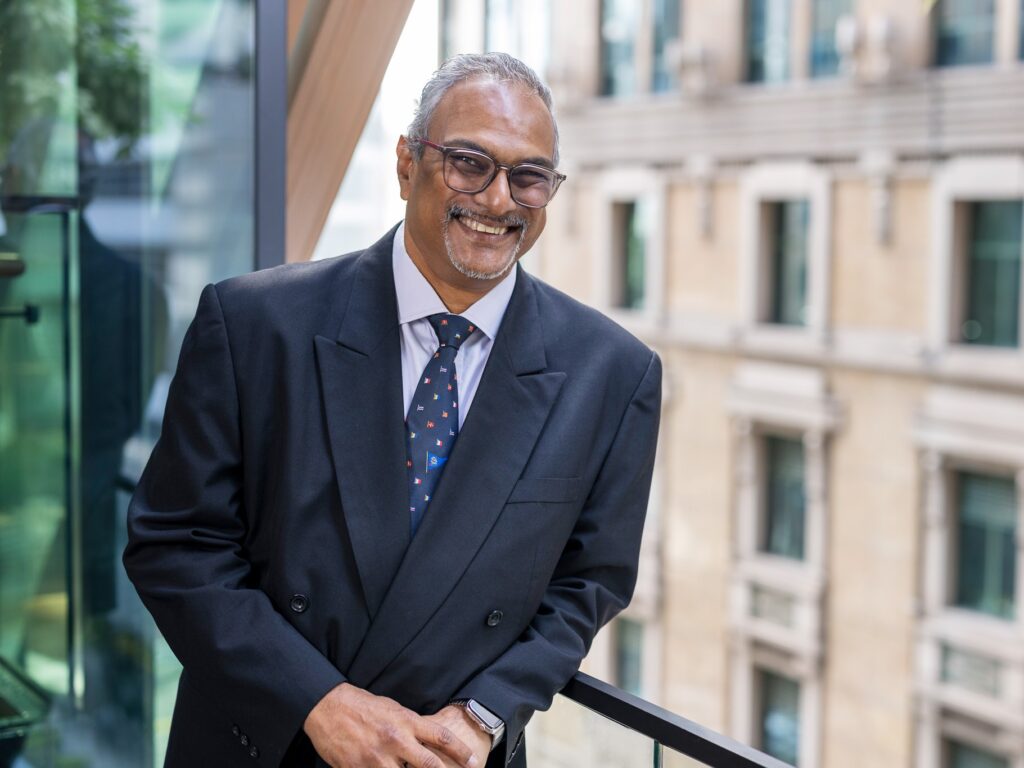
The last 33 years the key lesson for me in my learning journey has been about treating people with respect. I respect everyone, in and outside the office, as fellow human beings with different and vast experiences that I shamelessly listened and benefited from. Leading and managing people well, will have a direct and positive impact on the business and organisational outcomes. Success will follow when you have a talented, energised and inspired workmates around you. I try to inspire and be inspired. I have never let my past abilities limit my courage to learn new things.
When asked about conceiving and teaching the course I accepted the challenge. I used educated prompts, leveraging my past experience, to use AI to develop the course material. To conceive the storyline, I reflected on my own journey of understanding every time I entered a new domain where I often started from the bottom of the learning curve. Knowledge is like an onion, try not to cut straight to the core, you will cry, you peel layer by layer and you will learn.
2. From your perspective, why is the topic of marine green fuels particularly challenging for industry professionals to navigate today?
My experience at EMA gave me a broad understanding of the complexity of the energy sector and its subtleties.
In my view, industry professionals have too many variables to juggle. Industry professional must consider from perspectives of policy and corporate governance management, technical constraints, operational reliability, commercial demands, compliance implications, workforce and market readiness, which needs to overlay on every vessel for specific trade route and their port-of-call ecosystem and policy readiness. The level of uncertainty and variability for each of these factors causes procrastination and inertia to maintain the status quo and manage near term issues rather than make strategic long-term decisions.
3. How did your experience across both public and private sectors influence the way the course was conceptualised?
It gave me an understanding the complexity of articulating policies that must have an equitable impact on the ecosystem whilst balancing the commercial realities of the private sector. The course doesn’t explicitly address this but is implied to those who are attentive.
4. How did you and Mr Qin work together during the course development process, and how did your respective backgrounds complement one another?
Truth be told I never have met Mr Qin till he was presenting, but I knew I wouldn’t be able to do justice to the attendees to deliver meaningful knowledge and insights on case studies from China. So, I was glad he was able to deliver, and I had the privilege of sitting through his session, listening attentively.
5. What key takeaways or capabilities do you hope participants gain by the end of the course?
Adopting alternative low carbon fuel is not just a commercial decision there are many considerations that require careful evaluation. Comprehensive oversight must come from multifunctional teams with their specific fiduciary responsibilities to provide a holistic picture of balancing multiple priorities and obtaining the best net outcome to deliver the vision and mission of their organisation.
Leadership gumption and clarity is key when managing and executing these complex changes affecting people, processes and profits.
Click here to read more about Dr Sanjay’s career and some of his key lessons learnt.
Foundations in the Energy sector – ExxonMobil
My foundations in the energy sector were shaped by my 11+ years at ExxonMobil. Here, I was involved in field technical support, product marketing, channel management, business development, refinery process engineering and business analysis, as well as regional technical advisory and services.
Strategic Problem-Solving – McKinsey & Company
My stint of almost five years at McKinsey & Company helped me apply my knowledge and understanding the multinational and National Oil & Gas companies in problem solving not just operational needs but also leadership and governance.
Public Sector Leadership – Energy Market Authority (EMA)
I entered the electron energy vector world when I joined EMA as Director of Industry Development. At EMA, I was tasked with driving the electric vehicle program and Pulau Ubin renewable grid project, initiating the Smart Grid program, and establishing the energy innovation research program.
These portfolios, coupled with my earlier experiences, gave me a broad knowledge base of the energy sector’s complexity and subtleties. Ploughing through hundreds of innovation proposal gave me greater understanding of the problems faced and the possible approaches in solving them.
Expanding Across Energy Systems – DNV
I joined DNV Clean Technology Centre armed with good foundation of the energy vectors (molecules and electrons) and their associated supply chains and challenges. At DNV, I began to learn more from my colleagues who were experts in solar, wind, power grids, energy efficiency, and safety in oil and gas, shipping, and ports. Each project proposal, customer discussion, conference, and webinar, built towers of knowledge for myself sitting on top of the foundations that I nurtured over the previous 18 years.
Digital and Multi-Energy Systems – Energy Research Institute @ NTU (ERI@N)
When I entered ERI@N, I was appointed the Program Manager for the Smart Multi-Energy Systems initiative. There, I led five work streams via five competent principal investigators and researchers to build a software for managing multi-energy flows across power and temperature delivery systems. That is when I began to scratch the surface of the knowledge around software development, machine learning and AI. Pushing my personal boundaries further.
Driving Maritime Innovation – Singapore Maritime Institute (SMI)
The opportunity to lead SMI which focused on innovation was too tempting to pass up. So, I entered the maritime sector and was at the heart on innovation to address the Maritime Transition across, ports (land and sea space) management, cybersecurity, safety and decarbonisation. Being the advisory board of the centres of excellence covering all these domains and reviewing research proposals gave me an intimate insight to the issues and potential pathways to solving some of the major challenges the maritime sector was facing. Here, I helped develop problem solving frameworks to scope and ideate projects that would be useful in my subsequent role at the Global Centre for Maritime Decarbonisation (GCMD).
Global Impact – Global Centre for Maritime Decarbonisation (GCMD)
As the founding Chief Technology Officer, other than choosing the most talented Directors of Projects I could lay my hands on, my accumulated experience and knowledge helped co-ideate projects and seminal studies that would place GCMD on the global map despite its youth. In almost four years, I played a key role in ideating and executing almost 20 projects/studies/reports, as well as two global maritime surveys covering key aspects of maritime decarbonisation.
Continuing the Learning Journey – Singapore Institute of Technology (SIT)
My 9th pivot into SIT (my 10th job) is now yet an exciting phase of my learning journey. Whilst I lead now through influence not authority, I continue to learn by asking questions and challenging the status quo respectfully, to willingly guide and help those around me succeed and discover my own areas that needs to be challenged to feel alive – a discomfort with the status quo – energise.