As the maritime industry works towards net-zero emissions, understanding alternative fuels and their associated supply chains is becoming increasingly important. We spoke with Mr Qin, Technical Manager at China Classification Society (CCS) and trainer for SSA’s Fundamentals of Marine Green Fuels course, to gain insights into the evolving regulatory landscape, fuel safety considerations, and developments in green fuel production.
1. As Technical Manager at CCS, could you share your role in supporting shipping decarbonisation and how it informed your contributions to Fundamentals of Marine Green Fuels course?

At CCS, my work involves supporting the maritime industry in understanding and applying decarbonisation-related regulations, safety requirements and technical standards. This includes monitoring IMO and EU regulatory frameworks, alternative fuel safety requirements, fuel lifecycle assessment, and the practical readiness of green fuel supply chains.
For this course, my contribution focused mainly on methanol and ammonia supply chains, particularly from the perspective of China’s emerging green fuel production and bunkering capabilities.
I shared practical case studies on green methanol production pathways, supply chain development, bunkering readiness at Chinese ports, and the key safety considerations for methanol and ammonia as marine fuels. My aim was to help participants connect the regulatory and technical concepts with real industry developments, so that the discussion would not remain theoretical.
2. From your experience working closely with regulations and standards, why is it important for industry professionals to build a strong foundational understanding of alternative fuels?
Alternative fuels are not simply a replacement for conventional marine fuels. Each fuel has different characteristics, risks, production pathways, infrastructure requirements and regulatory implications. For example, methanol is easier to store and handle as a liquid fuel, but it has issues such as low flash point, toxicity, invisible flame and material compatibility. Ammonia has the potential for zero carbon emissions during combustion, but it brings major challenges in toxicity, NOx and N2O emissions, technical maturity and public safety.
A strong foundation is therefore important for making informed decisions. Industry professionals need to understand not only whether a fuel can reduce emissions, but also how it is produced, whether it can meet lifecycle GHG requirements, whether the supply chain is reliable, and whether the safety risks can be properly managed. This knowledge is essential for shipowners, managers, ports, fuel suppliers and regulators as the industry moves towards multi-fuel operations.
3. What were some key considerations when translating complex technical and regulatory topics into a structured learning programme?
One key consideration was to structure the course around the full fuel supply chain, from feedstock sourcing and production pathways to transport, storage, bunkering and onboard use. This is important because the environmental value of a green fuel depends not only on its use onboard, but also on its lifecycle emissions from Well-to-Wake.
Another consideration was to make the content practical and relevant to industry decision-making. In my session, I used China as a case study to explain green methanol and ammonia availability, production capacity, logistics, bunkering ports and future demand. For example, the lecture covered green methanol projects in China, potential e-fuel capacity, methanol bunkering pilots in Shanghai, and future fuel demand scenarios under IMO GHG targets.
We also wanted participants to understand that fuel selection is multi-dimensional. It is not only about carbon reduction. It also involves safety risk, technology readiness, fuel availability, accounting methods, lifecycle GHG savings and economics.
4. What was it like collaborating with Dr Sanjay on the course, and how did your respective expertise come together during the development process?
It was a very constructive and complementary collaboration. Dr Sanjay brought a broad system-level perspective on marine green fuels, covering the universal supply chain framework, sustainability requirements, lifecycle assessment, ports as multi-fuel energy hubs, fuel availability, investment trends, and biofuel supply chains in ASEAN.
My contribution complemented this by focusing more specifically on methanol and ammonia supply chains in China, including fuel characteristics, production pathways, supply potential, bunkering readiness, safety risks, regulatory considerations and economic factors under the IMO Net-Zero Framework.
Together, we combined a broad regional and sustainability framework with detailed fuel and market-specific case studies. This helped participants first understand the overall logic of marine green fuel supply chains and then see how these concepts apply in practical cases such as methanol and ammonia development in China.
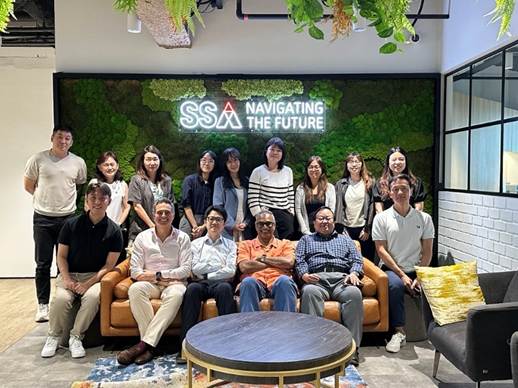
5. What types of professionals do you think would benefit most from attending this course?
This course would be useful to a wide range of maritime professionals, especially those involved in fleet management, technical operations, regulatory compliance, sustainability, fuel procurement, port operations, bunkering, ship design and business development.
It would also benefit professionals who may not be alternative fuel specialists but need to understand how green fuels will affect the future of shipping.
As the industry decarbonises, fuel decisions will increasingly affect ship design, operational planning, safety management, crew training, port infrastructure, commercial strategy and regulatory compliance. A foundational course like this helps different stakeholders build a common understanding and have more informed discussions on future fuel choices.
For future runs of the course, please visit the SSA Courses Calendar or email training@ssa.org.sg to stay updated on upcoming training dates.